|
The Enigmatic Plummet Stone - A New Look At An Old Mystery
|
by Derek Mays |
| Central States Archaeological Societies 2026
January Journal |
Rock City, Illinois |
|
This issue of the Central States Archaeological 2026
January Journal can be purchased on-line after March 2027
|
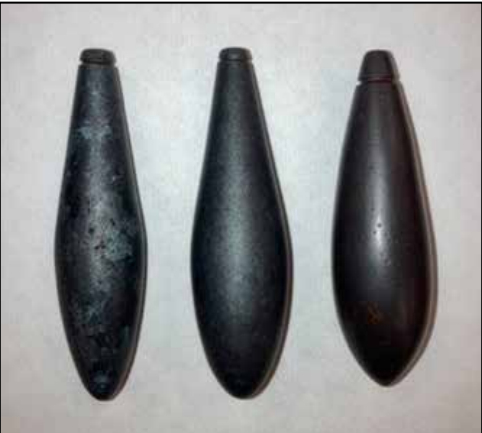 |
| Figure 1. Three high quality plummets from various counties
in Illinois. The material and workmanship are of such high-quality, it
makes it a far-fetched idea to believe they were used as net weights
or bolas. |
The North American Native plummet stone has long been an ancient object
of mystery and controversy among professionals and amateurs in the
world of archaeology. There have been a few theories proposed and written
on the topic, but none have really passed the litmus test with any
amount of certainty. People have argued and debated the possible use
of plummet stones since they were first discovered on ancient camp
sites which dot the majority of the North American continent. Theories
include ancient cast net weights for fishing, bolas for tangling up
the legs of prey, weights for the process of weaving textiles, and
some even feel they may have served as an object carried by a prehistoric
medicine men as a talisman.
For me, I have never been able to fully accept these theories. Well, at least
not since I began collecting examples of plummets for my personal collection.
I will explain my doubts about these theories in more detail a little later
in the article. But first, I feel it is necessary for me to share where
my plummet fixation shifted from inquisitive to somewhat obsessive. I obtained
my first plummet in 1991 or 1992 at the Collinsville, Illinois relic show.
I paid $65.00, a week’s worth of yard mowing wages, for a small hematite
plummet from Floyd Ritter. After asking Floyd a few questions, he kindly
told me to go track down Greg Perino. “Greg”, Floyd said, “He
has a better understanding of those things than I do.” After receiving
help from several people, I finally located Greg seated behind a table
full of books and journals visiting with a few other collectors. I was
16 or 17 at the time and had a mind that never seemed to shut off until
I found answers. Greg was a well-aged man with a soft voice, kind demeanor,
and a warm smile. After introducing myself to him, telling him my interest
in plummets and questioning him about their possible use, I soon realized
he had some of the same questions. After about ten minutes of conversing,
I could tell that his mind seemed to be very active too and he had a deeper,
more passionate interest in the plummet stone than I had. Even though this
was the first time I had met Greg, he spoke to me like he had known me
forever. Greg then stood to his feet and was fumbling around through the
books and journals on the table while briefly explaining how there really
were not any definite answers to our questions about plummets. Soon he
located a small paperback journal, opened it up to an article he had written,
and told me to read the article when I got home. I quickly let him know
I could not pay the seven-dollar price tag because I had just spent all
of my money on a plummet. Greg simply responded, “It’s a gift
from me to you”. The journal was the Illinois State Archaeological
Society 50th Anniversary Issue published in October 1986. That kind act
persuaded me to eventually start saving my mowing money to join the Central
States Archaeological Society in order to receive their quarterly journals.
To this day, I still retain the exact copy of the CSAJ Greg Perino unselfishly
gave to me. Likewise, I have retained my membership in the CSAS, receiving
the quarterly journals each year.
Why am I not convinced plummets were net weights or bolas? I feel it is
a pretty easy reason to defend.
I have always been of the opinion that since the majority of plummets were
manufactured of such scarce materials and were crafted to such a high degree
of quality, there is no way a reasonable person would spend hours upon hours
making such an object only to risk easily losing it in a muddy marsh or equally
risk exposing it to certain damage by slinging it through the air at a moving
animal.
To me these are nonsensical theories, especially since Natives were highly
resourceful people. If used as a net weight or bola, common sense would tell
one to find a stone that was naturally shaped to serve the purpose and save
the time and energy of having to locate the exotic material and painstakingly
craft one. This alone should lead us to believe there had to be a more sacred
or methodical purpose for the plummet than exposing it to such pummel and
batter after hours of labor to make it.
Could plummets have been used by prehistoric medicine men - I suppose that
is a possibility. However, sites in my area that produce plummets, generally
produce several examples. In some cases, a few sites have produced a dozen
or more. I find it difficult to believe that one clan of Natives would have
that many high status medicine men at the same time.
As far as plummets being used as weights to help weave textiles, I am highly
suspicious of that theory as well. In the process of interviewing collectors
and scholars, I was assured that plummets were...
Read other great columns in the Central States Archaeological Societies 2026
January Journal which can be purchased on-line after March 2024
|
|


