|
Stylistic Similarities to the Fox Valley Point
|
by Edmund A. Butkus |
| Central States Archaeological Societies 2026
January Journal |
Crown Point, Indiana |
|
This issue of the Central States Archaeological 2026
January Journal can be purchased on-line after March 2027
|
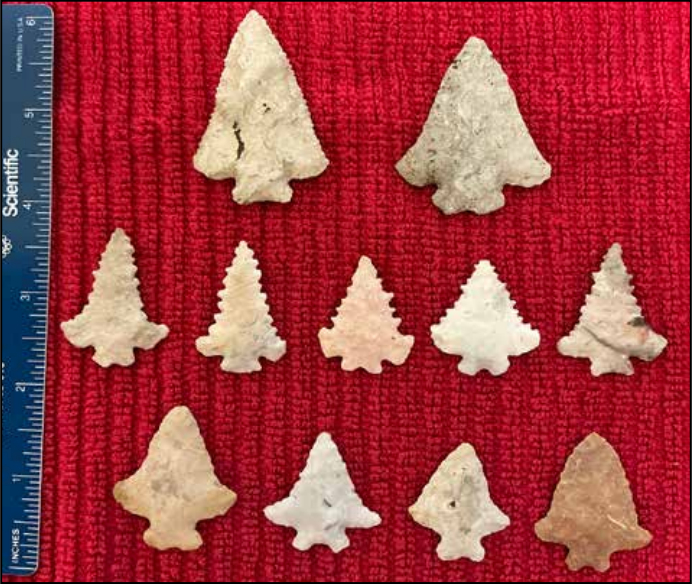 |
| Figure 1.First row - Large Fox Valley points from LaSalle and Peoria
Counties, Illinois. Second row - Classic Fox Valley points from Cook
and Will Counties, Illinois with the center point from the St. Louis,
Missouri area. Third row - Variants of the Fox Valley point from Kankakee
County, Illinois |
For many years the writer has been intrigued with the classic Fox Valley
Archaic projectile point also known as the Clipped Wing point. The
distinctive style, possible functionality and relatively small distribution
range, are what makes this point so fascinating.
The actual use of the Fox Valley point has never been proven, but only speculation
as being used as a fishing or aquatic mammal hunting point. The Fox Valley
point is found both with and without serrations. Workmanship can vary from
thin finely worked points to average quality examples. Most Fox Valley specimens
are small size points with some larger ones being over two inches in length
(Fig. 1). These points have small straight bases that sometimes have a small
basal notch. A variety of lithic materials are utilized for knapping these
points from local and non-local sources. Many Fox Valley points are made
of from local lithics found in northern Illinois such as pebble chert, glacial
chert, Starved Rock flint and Des Plaines Valley chert. Some of the non-local
cherts employed are Attica chert, Burlington flint and a variety of other
non-local stone materials. There are variations of the Fox Valley point that
are from the same cultural time period that are found further east and southeast
of the heart area where the classic Fox Valleys were recovered in larger
numbers. The heart areas for classic Fox Valley points appear to be in southern
Wisconsin and northern Illinois and occasionally outside the main area. The
Fox Valley variant is sometimes found within the heart area and then becomes
more prevalent further east into Indiana and beyond. The writer will show
the difference between the classic and variant forms in the accompanied photograph.
The writer has seen classic Fox Valley points found far from their normal
range that were found in the St. Louis, Missouri region and a single specimen
from Louisiana.
The main focus of this report is to demonstrate similar style points that
mimic the Fox Valleytype that are found in two entirely different environmental
zones in the United States and are from later cultural time periods than
the Fox Valley types. The writer is not saying that all these points are
similar, but a few are as seen in the accompanied photos. These similarities
are very interesting, but are most likely just a coincidence. People past
and present are motivated to change things because of adaptation to new environments,
that result in new types of lodging, clothing, tools and what they hunt and
eat according to their new environment.
The first environmental zone where these similar point styles are found
are ...
Read other great columns in the Central States Archaeological Societies 2026
January Journal which can be purchased on-line after March 2024
|
|


