|
A New Test for Old Copper Fakes
|
by Dr. E. J. Neiburger |
| Central States Archaeological Societies 2026
April Journal |
|
|
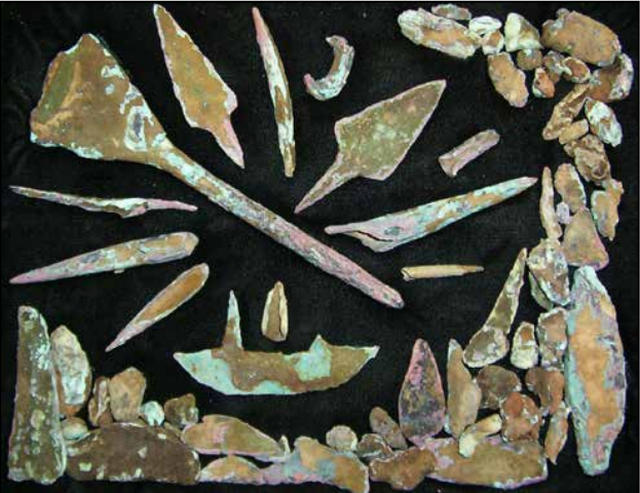
At top: Figure 1. Authentic Old Copper Culture artifacts. They exhibit
well fixed, multi colored patinas, standard shapes and sizes along with many mini ingots (hammered lumps of float copper ) used as trade
tokens. Compliments of Steve Livernash.
|
Old Copper Culture (OCC) artifacts are in great demand and quite expensive.
They are products of the Old Copper Culture which was once located in the
Upper Midwest and East Coast of North America (Figs. 1,2).
A billion years ago copper metal deposits were formed deep in our planet's
crust. Tectonic activity forced some of this subterranean metal up to the
earth's surface producing what geologists call "float or native copper." This
mineral was scraped from seams in the bed rock by glacial activity, crushed
and broken into a wide variety of different sized pieces (Figure 3). Float
(native) copper was spread over the landscape and throughout the world. This
copper was much different from the commonly deposited copper ore which is
usually found in combination with other elements such as sulfur, carbon and
iron.
Float copper is unique because it is most often, ultra pure copper metal.
Occasionally it is mixed with metallic silver, antimony or arsenic. It may
come with a loose surface coating of minerals such as malachite, cuprite,
or tenorite. Float copper is so pure that it does not need any special refinement.
Because of this nature, float copper is soft and can easily be wrought worked
(hammered, bent) and polished. Increased wrought working will harden the
metal. Low heat annealing treatments will soften it.
Modest deposits of this metal can be found in present day Kazakhstan, Turkey,
Iraq, Mexico, Bolivia and the Balkans. The world's purest float copper
(99.9%) occurs in North America: mainly on the East Coast and especially
in the upper Midwest (Michigan, Wisconsin, and Minnesota) where most of
the world's supply can be found. Ancient American natives collected the
float copper on the earth's surface, in lakes and in shallow mines. So
plentiful was the float copper that it is estimated that hundreds of tons
of the pure metal was collected between 9500 BCE and historic times by
Indians of the Archaic, Woodland, Hopewell and Mississippian cultures The
people of these periods were part of the "Old Copper Culture "(OCC).
Modern float copper mining began in the 1840s and continued through 1910
CE.
The Natives fashioned a fantastically wide assortment of tools, weapons,
jewelry, art and religious items from this easy to cut, hammer, grind, bend,
swage and polish metal. For thousands of years, polished float copper was
treasured as the brightest element in a rather grey, dingy world and was
given a magical reputation. Small hammered lumps were treated as primitive
money
and traded widely (Fig. 2).
Unlike iron, copper is insoluble in water and fairly corrosion resistant.
Artifacts made from this metal are very long lived and can be found intact
thousands of years after they were made. Because of the unique designs, art
and varied size specimens, collectors covet ...
Read the complete "A New Test for Old Copper Fakes" column
in the Central States Archaeological Societies 2026
April Journal which can be purchased on-line after March 2026
|
|