|
The Lesson of Mr. Ploenges Farm |
Jeff Anderson
|
| Central States Archaeological Societies 2001
October Journal |
Greenfield, Indiana |
I
grew up in the country close to the Indianapolis Indiana area. In late 1983,
when I moved from St. Louis back to Indianapolis, I was looking forward to
meeting old friends and searching for Indian artifact in my home state. Little
did I realize that many of my best finds would actually be found within a few
miles of where I grew up.
Through the winter of 1983 and the spring of 1984 I traveled throughout the central
Indiana area, sometimes driving for an hour or more to search for fields to hunt.
Finally, after limited success in my wandering, I stumbled across a suitable
field.
I grew up during the 1960s outside of a small town called Cumberland, which has
since been engulfed by the urban sprawl of Indianapolis. Cumberland, until the
growth boom, was a small town with many German farm families in the surrounding
area. As most small boys living in the country, we played in many of the farm
fields both while crops were planted and after harvest. Our families next-door
neighbor was an elderly farmer of German decent, Anton 'Andy' Ploenges, who was
born on his families farm land in a log cabin in 1883. He farmed the land until
he died in 1980.
When I was old enough I took over the job of cutting Mr. Ploenges lawn from my
older brother Greg. Mr. Ploenges was in his early eighties then and like some
small children, I was somewhat frightened of him. He was still active, butchering
cows and hogs, or working on his roof. Even then, Mr. Ploenges was a sturdy man
over six feet tall but the years of farming had taken their toll. Missing a few
fingers, and scaring from sun cancer on the side of his neck and face, made me
leery of staying close to him for very long.
 My
good friend Mike Hampton's family lived in the Ploenges' hired hands house
which sat across the road from the main farm house. During one of our country
hikes together in later years, Mike gave me a slate full groove ax found
by Mr. Ploenges many years ago. After Andy Ploenges passed away in the
mid 1980's another farmer who lives further up the road purchased the Ploenges
farm land. While visiting him prior to searching for Indian relics, his
wife mentioned during a conversation that Mr. Ploenges had a passion for
history and especially for the history of the Indians who once roamed this
area. This was confirmed by Mike's mother Liz one evening while visiting
her for dinner.
My
good friend Mike Hampton's family lived in the Ploenges' hired hands house
which sat across the road from the main farm house. During one of our country
hikes together in later years, Mike gave me a slate full groove ax found
by Mr. Ploenges many years ago. After Andy Ploenges passed away in the
mid 1980's another farmer who lives further up the road purchased the Ploenges
farm land. While visiting him prior to searching for Indian relics, his
wife mentioned during a conversation that Mr. Ploenges had a passion for
history and especially for the history of the Indians who once roamed this
area. This was confirmed by Mike's mother Liz one evening while visiting
her for dinner.
In the spring of 1984 my girlfriend, Theresa, and I were driving out by Cumberland
Indiana looking for a location to hunt arrowheads or search for old bottles.
As we drove down the county line road I remembered that there had been an old
barn on the farm which burned to the ground back in the early 1960s. Where the
road was once a dusty gravel road, a nicely paved road now stretched. Where the
barn once stood, now there was a cultivated field with only a few large trees
remaining by the road. We thought there might be an old bottle or two around
the site. Possibly something worth looking for since not too many people in the
area then remembered the barn.
Both of us were skeptical of finding anything yet I pulled the car off of the
road by a large tree and we got out to look around. We stood there talking for
a moment before I started into the field. On my first step into the field, with
one foot still on the road pavement, and the other planted in the moist dirt,
I paused to ask Theresa why she was hanging back. I looked back at her to see
her leaning against the car looking at me while she buttoned her coat. Without
saying a word I looked down by my right foot to the ground and saw a large corner
notched point protruding from the earth.
At less than two feet from the road side, the point was lying flat in the dirt
over eighty percent exposed. Only the extreme tip of the point was covered with
soil. I could not believe it. Here I had come to this spot to hunt for bottles,
and after driving all over mid Indiana, I find my largest point yet within site
of my boyhood home. I pointed to the point and called Theresa over to look at
it before I lifted it from the ground.
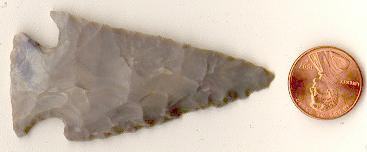
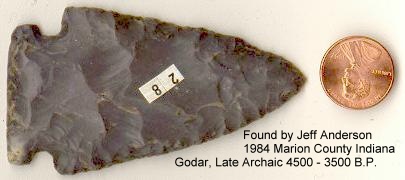
As I held it in my hand, I immediately recognized it a Godar type point. The
material is Indiana Hornstone, or Harrison County flint and is semi glossy.
Harrison County flint ranges in hue from a dark blue to black. The cross section
is flattened and has been re-sharpened from both sides. The relic is totally
complete without any damage.
The Godar is an Late Archaic relic dating between 4500 - 3500 B.P. typically
found in Illinois, Indiana, Ohio, Kentucky, Tennessee, Missouri, southern Wisconsin
and Arkansas. Examples typically range in size from 76 mm to 140 mm in length,
are narrow to wide side-notched with parallel sided blade edges when unsharpened..
The type also has straight to rounded side notched base which may or may not
be ground. The basal ears are generally rounded to square. The type was named
by Gregory Perino in 1963 for points he recovered from west central Illinois.
I have found many other points in the same field and fields in close proximity.
My brother Doug found a very nice fully polished slate celt within twenty feet
of where I found the Godar a year later. Three nice Lost Lake points, all made
of Harrison County Flint, have been found in the area by myself since finding
the Godar.
Finding such nice artifacts so close to where I lived for so long just boggles
my mind. I think back upon all the years I roamed the area, including Ploenges
field, I wish I had started hunting when I lived there and was so much younger.
I can look back through all those years, and I can still see my old home from
the spot where I now find so many wonderful Indian artifacts now.
|


